Limor
Zer Gutman
לימור
זר גוטמן
April 10, 2026
Hello, everyone.
I hope you and your loved ones are well after a holiday that wasn’t really a holiday but a war. There is no plenary meeting this month, so I will continue to report on several current issues and whatever else comes up throughout the month.
First topic: Beware of spraying!
Recently, residents have been reporting in neighborhood groups and on social media that spraying is taking place in various areas throughout the town—sidewalks, paths, and protected open spaces. This spraying endangers people and animals. The spraying is being carried out in violation of the council’s policies and decisions from the previous term (decisions that have not been changed), particularly since this policy was backed by appropriate funding. A policy that clearly prioritizes mowing/cutting weeds over spraying.
For example, there was a recent report of spraying in the Gibor Stream channel, which is an open urban area with trees, walking paths, and a neighborhood activity space maintained by the council and residents. Equally serious is the fact that residents are not notified in advance of spraying in their area so that people and dog owners know not to visit the sprayed areas.
During the 2025 budget discussion, I raised the alarm that the mowing budget had been cut from 80,000 NIS to just 50,000 NIS. Did those 30,000 NIS cut from this budget go toward funding two salaried deputies and a company car? And did the cut lead to what we are seeing on the ground—pest control instead of mowing?
Budget line 1742203750 in the budget book is designated for mowing roads and sidewalks:
In 2022, 35,000 NIS was budgeted; actual expenditure was 37,000 NIS
In 2023, 80,000 NIS was budgeted; actual expenditure was approximately 90,000 NIS
In 2024, 80,000 NIS was budgeted; actual expenditure was approximately 74,000 NIS
In 2025, only 50,000 NIS was budgeted, despite my warnings.
In 2026—the budget has not yet been submitted for approval, so we are at 1/12 of last year’s budget. But I hope that when the new budget arrives, the budget for mowing will increase dramatically. This is important.
This budget does not include or address mowing carried out as part of the contractor’s landscaping work in areas such as: Pas Stevens, the Gibor Channel complex, Langa Grove, Shazif Grove, Tashach Grove, Gan Guy, Aharon Grove, and other locations.
Second issue: Zero transparency and zero involvement of elected officials, even on security matters
Officially, there is a ceasefire in the war with Iran, but the battles and fighting in the north continue. To date, nearly 40 days into the war, the Local Council Security Committee has not been convened; we, the council members, have received no reports, and no discussion has taken place among council members, despite two council sessions having been held during this period.
This is a serious, irresponsible, and completely non-transparent course of action. Elected officials are not mere extras in the council head’s show. We are part of managing the community’s policies in peacetime as well as in wartime.
Just to give an example regarding shelters in public spaces: in neighboring communities, such as the Binyamina-Givat Ada Local Council, the public was informed that shelters had been installed in several public locations (with all their limitations in the event of a direct hit). Here, we are not informed, not consulted, and not included. We saw that a shelter was installed in Moshava Park. But what about other places where there are large gatherings? For example, the Golan Hazan field in Neve Sharet, which is far from a public shelter; the park in Givat Eden; public parks in Neve HaBaron or the Yaakov neighborhood.
What about the private parking lot that’s closed on Fridays and Saturdays even though it could serve as a protected space for nearby playgrounds (I’m referring to the parking lot at the shopping center at the top of HaKovshim Street, where Shufersal is)? Maybe we could ask or require the owners to keep it open. I don’t know. Because there’s never been a discussion at the plenary session, and they don’t involve us.
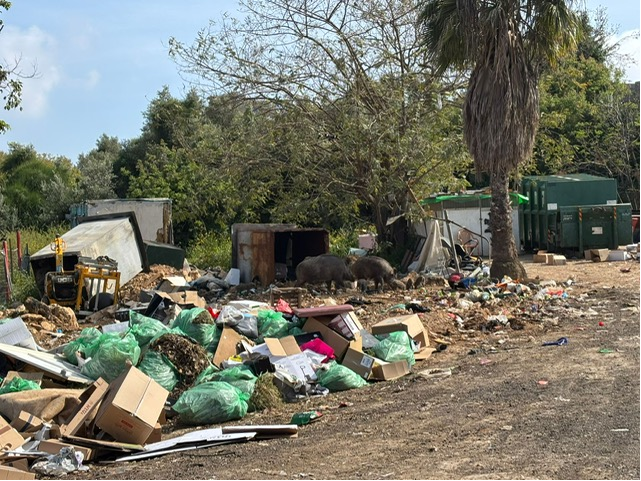
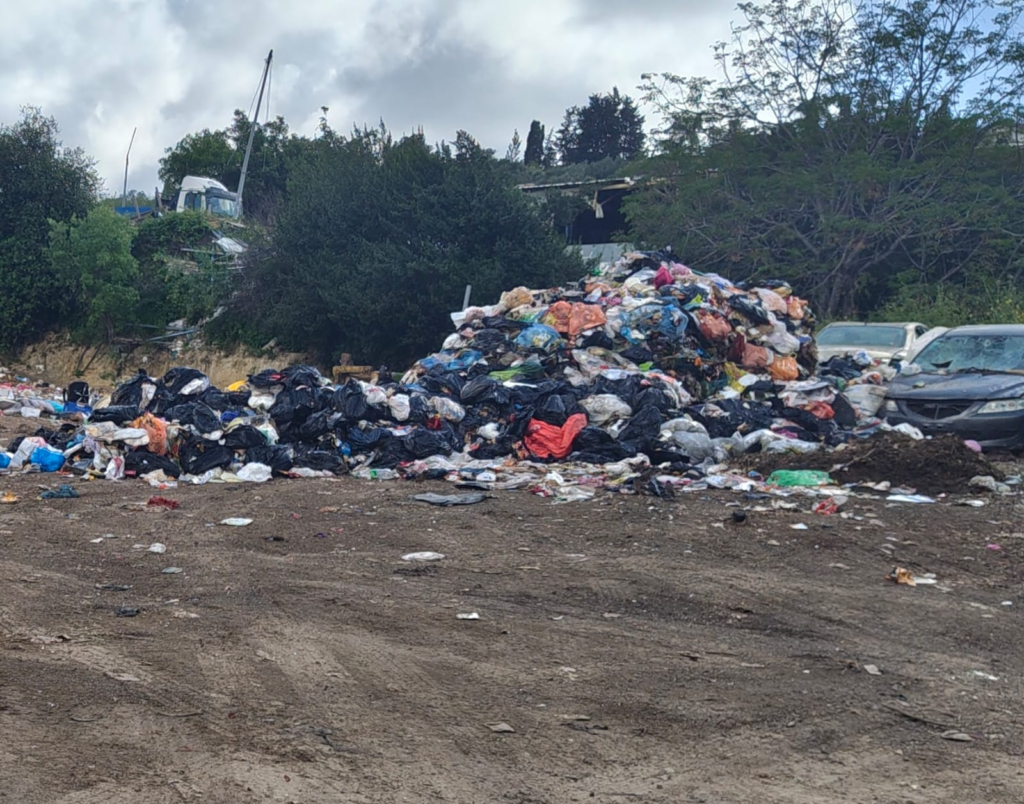
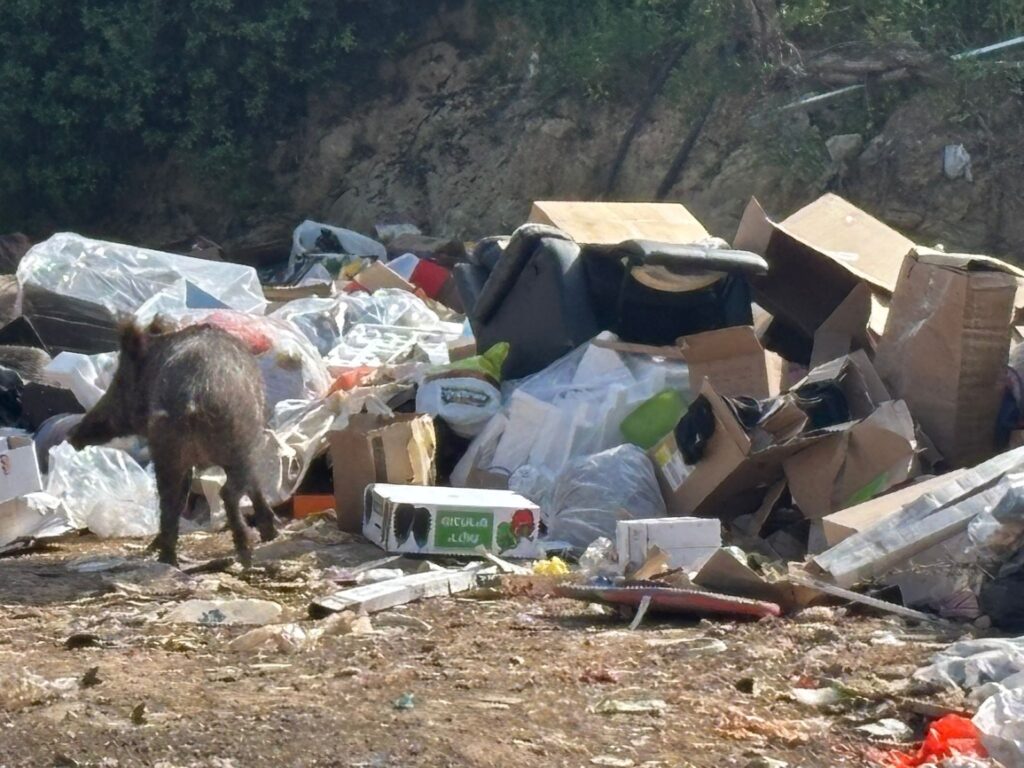
Third issue: You won’t believe what the dirtiest place in Zichron Yaakov is—it’s full of piles of trash, a stench, and packs of wild boars feasting on an all-you-can-eat buffet.
During the holiday, and as of yesterday at 4 p.m. when I arrived at the site and took these photos—there’s a new garbage dump in the heart of Zichron Ya’akov, on the grounds of the council’s operations department, on the way down from the winery toward Beit El. These are piles of stinking trash scattered in every direction by the wind, a 24/7 feeding ground for herds of wild boars (see the photos). And all of this is right where the council’s operations department is located. It’s ironic and infuriating that the Operations Department, which is responsible for keeping the town clean and collecting trash, has turned the very area it occupies into a massive, stinking dump.
Even if there is a shortage of waste disposal sites or a lack of trucks for transport—this is certainly not the solution. We need large, permanently enclosed containers where trash can be sorted by type until it is transported to disposal sites. The reality is a polluted area where various types of waste are scattered, neither treated nor stored properly until they are transported to treatment or landfill sites.
Unfortunately, due to the council head’s instruction to the professional staff not to respond to my inquiries, I feel it is necessary to inform the general public of this grim reality, in the hope that public pressure will also influence the handling of this serious hazard. I reported this to 106.
Fourth Issue: A Place in the Heart – Family Activity Area on Wingate Street
Kudos for maintaining an activity space even during the war, providing a sense of normalcy for young families and their children. “A Place in the Heart” offers personal activity spaces, workshops, story hours, parent-child activities, and more. A Place in the Heart was established during the previous term as part of a comprehensive approach to serve children from birth to age 3 for young families, as well as children up to age 6. This policy was formulated by the Council administration, led by Councilwoman Maskit Laufer and the Education Department, in collaboration with parent representatives and representatives of private preschools for children from birth to age 3. As part of this policy, the Department for Early Childhood (ages 0–3) was established within the Education Division; kindergarten teachers and staff at private kindergartens underwent training led by the Education Department in collaboration with the Haifa District; and safety inspections and training in kindergartens were conducted by the Security and Emergency Division.
This commendable initiative, which continues to this day, serves as a home for young families and a cornerstone of community resilience. For details and to join the program, please contact the Council’s Education Department.