
July 17, 2026
Hello, everyone,
This newsletter continues the update from the council meeting on July 7, 2026, and includes this week’s exciting announcement. Summary:
1. We voted in favor of expanding the Puah Daycare Center, which is owned by the council and currently has two classes, to include three additional classes in a new facility to be built in the Halomot neighborhood. This is important news for young families, for whom the daycare is in high demand.
2. Ronen Matlon, who was a council candidate on Tzila Reshef’s list and resigned from it before being appointed director of the council’s after-school programs, was elected to the board of directors of the Zamarin Community Center, headed by Tzila Reshef.
- Continuing from last week’s update on this topic—the council is funding the renovation of privately owned kindergartens operated by the Association for Torah Studies. We received a letter from the district supervisor at the Ministry of the Interior confirming the exceptional funding. However, questions remain.
- Good news for the community: after a process spanning several terms of council chairpersons, an agreement was signed this week under which the Open University is transferring the Langa complex—which it leases from the Israel Land Authority—to the council. We are now the lessees of 70 dunams. The agreement has not yet been brought before the council members for approval, so it is unclear to me what its terms are, and whether it includes the Purimon parking lot, where a residential neighborhood was planned to be built. This plan was rejected during the previous term.
- You are invited next Tuesday to the public presentation of the construction plan for Givat Zamarin
- Increase in the capital budget to fund the planning of three additional preschool classrooms
For those who aren’t familiar, the council-owned Puah Daycare Center is a tremendous success story. The center currently has two classes for children aged six months to three years. It is located on Derech Sarah. For several years now, the center has had waiting lists for enrollment.
During the previous term, as part of the vision to strengthen the community of young families—with the support and assistance of Councilwoman Maskit Laufer—the Early Childhood Division (for ages birth to three) was established as part of the Education Department. With the assistance of Maskit Laofer, Meir Vanunu, and the Education Department, the daycare center was transferred to the local authority’s management. Hundreds of thousands of shekels were invested in renovating, refurbishing, and equipping the facility. Most importantly, a professional and dedicated team was assembled.
In early 2023, the previous City Council plenary session approved 350,000 NIS for planning the expansion of the daycare center on land adjacent to the existing building, with subsequent plans to expand the project to include the construction of additional daycare classrooms in the Halomot neighborhood, bringing the total to six classrooms. The council at that time began working to obtain planning approvals from the Ministry of Education, and recently, in April 2025, the Ministry of Education granted the council budgetary authorization.
At the plenary session held on July 7, 2026, which I continue to report on here, we were asked to approve a total budget for the planning of three new preschool classrooms in the Halomot/Neve Sharett neighborhood, bringing the total to five preschool classrooms. Please note that budgetary processes of this kind take several years, followed by the construction phase—so it will take some time before the community has a network of five daycare classrooms. I welcome the continuation of processes that began during the previous term—this important step for the benefit of young families.
- Ronen Matlon Appointed to the Board of Directors of the Zamarin Association
Ronen Matlon, who won the tender to serve as the council’s after-school program director about a year ago, is a council employee. Ronen was elected at a meeting to replace Liron Fogel—also a council employee—on the Zamarin board. The community center is headed by Zila Reshef.
At the meeting, I asked: “Ronen Matlon was a faction member and a council candidate on the ‘Zichron ShebaLev’ list headed by Zila Reshef—so how can a political candidate be elected to this position?”
I was told that before winning the bid to become after-school program director, he had resigned from Zila Reshef’s faction.
- Follow-up on last week’s update—renovation of MALT kindergartens that were allocated funding
In a previous newsletter, I reported on the plenary session’s decision to allocate 241,000 NIS for the renovation of kindergartens belonging to the Center for Torah Education Association. The request was approved based on authorization from the district supervisor (as stated by the council chair, who did not present a document during the meeting)—authorization permitting the allocation of council funds to repair structural defects in a building belonging to a private association that had received an allocation from the council. An engineer representing the council determined that there is ground subsidence at the site of these kindergartens, which has caused structural shifts and problems—and therefore this is indeed the council’s responsibility. Since the district director’s letter was not forwarded to us as the council chairman had promised, on Sunday I wrote to the council chairman and all members of the plenary regarding the missing letter—and it was sent to us. Here is the link to the letter, which states:
“The structural engineer’s report indicates numerous defects and damages caused to the building, some in the structure itself and some in the building itself. In my humble opinion and based on my experience, the responsibility for repairing the structural damage found—such as building displacement, floor subsidence, cracks in the walls,defects in the building’s framework, and roof failures, is damage caused by natural wear and tear and has become time-barred; therefore, the responsibility for repairing them and funding those repairs lies with the local authority.”
It is difficult to argue with such a categorical letter, which indeed provides the legal basis for the exceptional funding granted to the MALT Association. However, I wonder: how is it that the Puah Daycare Center (which belongs to the council)—located right next to these two kindergartens—remains completely intact? There is no ground shifting or cracks there. How is it that the entire problem is limited to the association’s section? Or perhaps this is indeed the result of years of neglect by the MALAT Association. And how convenient that we are the ones paying for the maintenance, not the association. In any case, I have requested—and am still awaiting—an update to the bill of quantities and expenses so that they align with the supervisor’s approval.
4. This week, an agreement was signed under which the Open University is transferring the Langa complex—which it leases from the Israel Land Authority—to the council. We are now the lessees of these 70 dunams.
On Tuesday afternoon this week, during a festive ceremony held within the Langa complex, I participated as a council member in an important and moving ceremony—the Langa complex, which includes Beit Daniel, Beit Ruth, Beit Langa, and the surrounding fields—was transferred to the local council free of charge.
The lessee of this entire area is the Open University, which previously conducted activities there—and this week, as mentioned, transferred it to the council by agreement. The council chairman explained at the ceremony that he had been working to make this happen since his previous term; I know that Ziv Deshe also continued to work with the university during his term to facilitate the transfer of this land. In addition, the Zichron Ya’akov master plan strictly stipulated that public uses within the complex be preserved and that the site not be developed into a densely built-up real estate area. This provision, enshrined in the master plan, greatly contributed to the preservation of the site, and after the master plan was approved last year, it became possible to move forward with the agreement. Kudos to the current council chair and to everyone on the council who helped bring this long-standing effort to a close and secure this vast and important area for the council. (And I mean that without a hint of sarcasm.)
The council head stated that a public committee will be established to outline a vision for this site. The overarching goal is to establish a branch campus of a well-known university there and to offer programs in fields such as conservation, tourism, viticulture, and the arts in general. This is to attract young people to the community and to revitalize the center of the settlement, of which this entire area will now be a part.
The agreement they signed page by page at the ceremony was very long—it looked to be about 50 pages. And I have no idea exactly what’s written in it. But according to the law, as I understand it, this is a real estate transaction, so it must be submitted to the full council for approval—the council must review and approve the agreement. I promise to read every page and report exactly what’s in it.
Immediately after the ceremony, I sent two simple questions to the full council and the council chair—questions I’m sure you’ll also want to know the answers to:
- Does the land that the Open University transferred to us also include the parking lot where the Maccabi Purim festival takes place?
- Will council members receive a copy of the agreement, which may require plenary approval since it is a real estate agreement?
The first question is important—because the entire area actually belongs to the Israel Land Authority (ILA) under an agreement made in 1949 between the heiress Lilian Freundlander and the Jewish National Fund (JNF). During Ziv Deshe’s previous term, the ILA attempted to advance a plan to build 130 housing units on the parking lot site. The council strongly opposed this—and the plan was rejected. Therefore, it is important to ensure that the preservation of the area includes this parking lot as well and that no residential neighborhood is built on it. On the map below, it is marked as number 521.
The second question is critical to proper governance. The council chair does not commit to real estate transactions (even if the land is being donated); only the full council, acting on behalf of the council, makes such commitments, and the council chair acts accordingly by signing documents. Therefore, we must receive the agreement. There are many implications to transferring the land to the authority, and it is important that the council plenary—which is the sovereign body—be involved.
I don’t understand why I still haven’t received an answer to these two very simple questions. Again, this is part of a pattern of withholding information and a lack of transparency toward me—and, in fact, toward you. A short story that teaches a lot: Before the ceremony began, I met Deputy Mayor Zila Reshef there and asked her, “Who are we signing the agreement with?” Because we hadn’t been given this basic information, and I didn’t understand whether we were signing with the lessee or the owner. It’s a simple question that requires a two-word answer: The Open University (the lessee). Zila looked me in the eye and said she didn’t know. Yes, yes, negotiations with the Open University had been going on for a long time—she’d been the deputy for nearly a year and a half—and in just a minute, the ceremony would begin, during which they would announce who the other party signing the agreement was. And she was unable to give me an honest answer to this question.
Why? Because she’s apparently gotten used to a lack of transparency—to not having to answer a council member’s question. Concealment comes naturally to her. Even though this is ridiculous and exposes how the council really operates—with zero transparency.
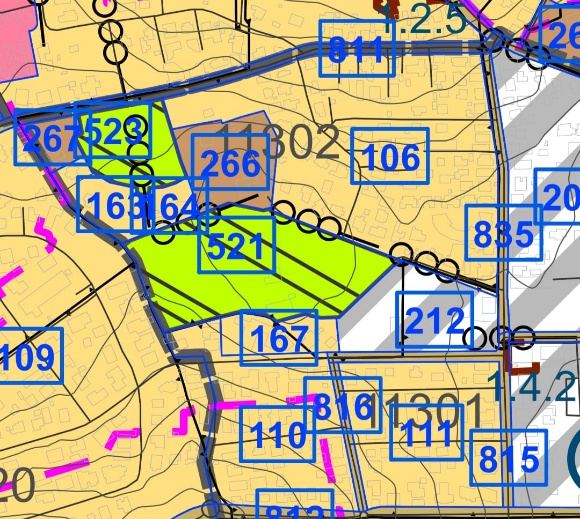
Complex 521—Parking Lot and Casuarina Avenue
Complex 266 – Beit Daniel
Complex 523 – Langa Grove
5. You’re invited to attend the public presentation of the Givat Zamarin construction plans next Tuesday
Next Tuesday, July 21, 2026, at 7:00 p.m., a public presentation of the Givat Zamarin project will be held in the Zamarin Community Center auditorium. Much of the hill is privately owned, and the plan is to build a residential neighborhood there alongside galleries and hotels.
I recommend attending, listening, and asking questions. The plan, which apparently already exists and was approved in 2016, will be presented to the public. I will, of course, be there and will report back to you in the next newsletter.