
June 5, 2026
Hello everyone.
This week, the regular Council plenary session was held on the first Tuesday of the month. I was not present at this session because I was at the Bar Association conference in Eilat, where I spoke on a panel discussing attorney conduct (one of my areas of research). Seven council members were absent from this plenary session: five from the opposition and two from the coalition. At the start of the meeting, the mayor chose to accuse and lash out at the opposition members for intentionally skipping the meeting and violating our duty to represent the residents. Of course, he didn’t check with us before making those remarks; had he done so, he would have seen that it was just a coincidence—each of us was absent for our own valid reasons.
What’s interesting is seeing what a meeting looks like when it consists only of coalition members—it lasted exactly 15 minutes! Everything was approved; there were almost no questions and certainly no objections. The agenda included at least two weighty issues that warranted many questions—even though it was clear they would be approved due to the coalition’s overwhelming majority. This shows just how important it is to have an opposition that prepares for every discussion, raises questions, and doesn’t accept every answer as gospel.
- First item: The agreement with the developer of the large construction project on the big parking lot behind the pedestrian mallwas approved. How much was paid, who profited, and who lost out.
- Second topic: Two budgets were approved for computers at Moshava High School and Pelach Girls’ High School. The addition of computer labs is intended to meet the Ministry of Education’s requirements regarding computerized matriculation exams.
- Third item: The response I received to an inquiry I submitted to the council head regarding how many tons of yard waste are collected in Zichron Ya’akov each year and transported to the Beit El composting plant. The figures are low compared to what could be recycled as clean garden waste. Therefore, it is imperative that the council and we, the residents, rally behind this important environmental project.
First topic: The “Hatzarot HaMoshava” Project. The council plenary approved the agreement with the developer. In my opinion, this is a win for the developer and a loss for the residents.
This involves a 3.5-dunam plot owned by the council, located at the rear of the pedestrian mall between Jabotinsky Street and HaNadiv Street/the pedestrian mall. Currently, there is a large parking lot on the side bordering The Hobbit Pub and Danka Restaurant. A decade ago, a specific zoning plan was established for this area, allowing for construction.
According to the agreement with the developer who won the tender for this site, two 6-story buildings (currently) for residential and commercial use, as well as a five-story underground parking garage with 270 parking spaces, of which 170 will be transferred to the council.
In exchange for the land, the developer will pay the council 7,000,080 NIS. Yes, you read that correctly—7 million NIS for land valued at over 30 million NIS. The reason for the very low price is the developer’s commitment to build a five-story underground parking garage. Here, read for yourselves the excerpt from the council’s legal advisor’s letter to the plenary session explaining why the agreement should be approved.
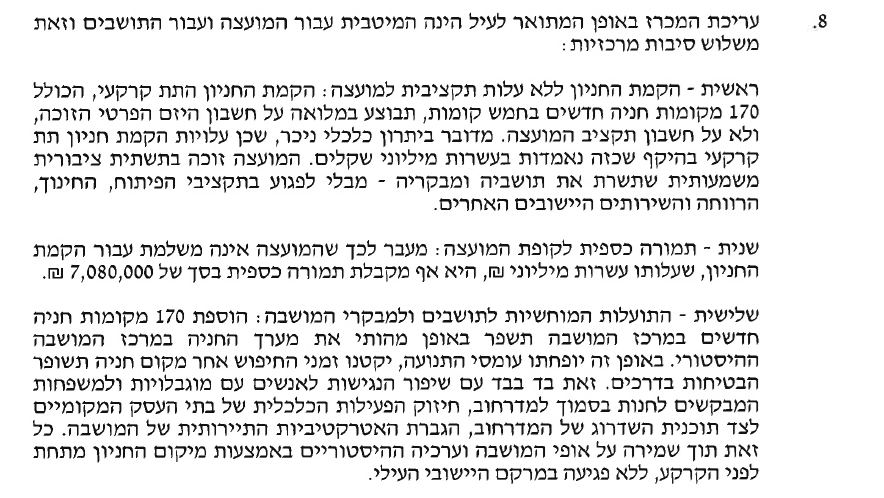
With all due respect, I disagree with these points and will explain why shortly. You are free to adopt either of the two positions. I have included links to the full agreement and the legal advisor’s letter below.
Regarding the first reason—the benefit of building the parking garage at no cost to the council’s budget—there are already 70 parking spaces on this site today, so the benefit to residents of an additional 100 parking spaces—which will likely be with paymeny—does not, in my opinion, justify such a low price. It would be better for the land to remain as it is, with environmental development and without the two towers.
Regarding the second reason, concerning the 7 million NIS payment by the developer—the payment could and should have been several times higher.
Regarding the third reason: How can a massive construction project that will paralyze the area for three years and erect two towers on the pedestrian mall be described as “enhancing the attractiveness of the town”? All this while preserving the historic character, without harming the upper-town fabric.” There is certainly harm to the upper-town fabric because two 6-story buildings are being built (who can guarantee they won’t be taller?).
There are already commercial spaces standing empty on the pedestrian mall and nearby. Why add more apartments and more stores?
In my opinion, there is no vision and no plan for the town. On the one hand, they are renovating the pedestrian mall and seeking to extend it to Hanadiv Street up to the winery, which will undergo preservation to preserve the history of Zichron Ya’akov, while the other is allowing a non-essential construction project that will result in two towers looming over the historic pedestrian mall. When informing residents about the residential neighborhood to be built in the winery area, the mayor explained at length that we must preserve the history of Zichron Ya’akov for the benefit of the entire Jewish people. So how does the construction of two buildings in the heart of the historic area fit with that? According to the legal advisor’s letter, this “preserves the historical values of the colony.”
Another issue: the contract is dozens of pages long, and we received it 48 hours before the meeting. While this is legally permissible, it is highly problematic—how can one prepare in such a short time for a discussion of this scope?
I recall what I wrote in Newsletter 79 regarding the council meeting in March of this year when the plan was presented to us—the council head did not answer any of the questions I raised, some of which were questions passed on to me by residents. For five minutes, he just kept telling me, “Move on,” “Move on.”
I wrote then: Huge construction projects are being pushed through without any real discussion, without answers to the questions. These questions aren’t mine—they’re yours. I am not a construction developer and have no interest in Zichron Ya’akov real estate. I am asking these questions on your behalf. When they won’t let me speak, and when they don’t answer my questions—they aren’t answering yours. The residents do not interest the council head and his coalition partners.
It’s true that I wasn’t at this week’s meeting where the agreement was voted on, but there is no chance—and there never was—of convincing the coalition members to vote against this agreement. I remind you that the coalition has an absolute majority of 10 to 5. The agreement with the developer now requires approval from the Ministry of the Interior. Unfortunately, here too, the Ministry of the Interior automatically backs the head of the local authority. Especially since there is an opinion from the council’s legal advisor stating that everything is in order. But I wasn’t elected to give up before even trying.
You can find the legal advisor’s letter and the contract we received at this link, starting on page 8. https://drive.google.com/file/d/1cE3YmWHGI8_U9k_YvY4rGaDHfq6K9L56/view?usp=sharing
Second item: Two budget requests for computers for Moshava High School and Bnot-Pelech High School were approved
Two budget requests for computers for Moshava High School and Pelech Girls’ High School have been approved. During the meeting, it was noted that as a result of the shift of some matriculation exams to computer-based testing at the schools, the schools must be equipped with a sufficient number of computer labs. Although the Ministry of Education changed the format of some of the matriculation exams, it did not allocate funds for the change, so each local council is required to finance the new computer labs on its own. The funds will come from the Mifal HaPais Fund, from which every local authority in the country receives an annual allocation (the amount varies by authority).
Third issue: Clean yard waste collection—how much is collected and what needs to be done to improve.
As part of my efforts to improve quality of life and the environment, I examined the efficiency of handling the garden waste we produce and the extent to which the council is addressing—or failing to address—this issue. Separating garden waste from general trash is one of the ways we residents can help reduce environmental harm and promote the concept of a “sustainable circular economy.” Starting in 2022, the council launched a program for the separate collection of garden waste from general trash. The council operates a dedicated collection route for clean garden waste and transports it to the “Compost Carmel” site in the Beit El community. Here is a link to their website: https://carmel-compost.co.il/
In our community, which has many public and private garden areas, the amount of garden waste is estimated at thousands of tons per year. Every ton of garden waste that is not sent to a landfill as waste/scrap but rather to a garden waste treatment site saves the public approximately 200 NIS per ton. This represents a potential savings on waste disposal costs amounting to hundreds of thousands of NIS per year. Money that could be utilized for the public’s benefit in the areas of education, culture, community, and more.
Therefore, as part of my work for the public and the community and to make information accessible, I submitted an inquiry on this topic, asking to determine the volume of clean garden waste collected from 2022 to 2025. The data is not encouraging. See the photo of the response I received to my inquiry. *Number 1 refers to another inquiry I submitted, which I will discuss in the next newsletter.
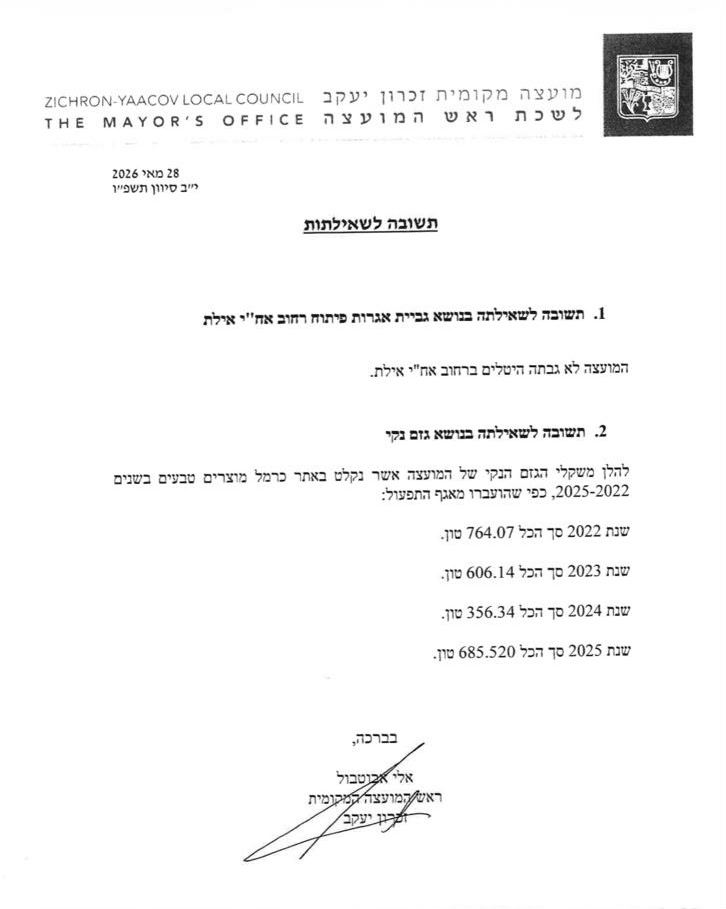
There is a sharp decline in 2024, which, according to the mayor at the meeting, was due to the war. It is unclear what the connection is between the war that broke out in October 2023—a year in which there was no decrease in the amount of garden waste collected—and the dramatic drop in 2024. In all years, the amount collected is low relative to the potential amount of garden waste that could be collected. There is no doubt that the council must significantly improve its efforts in this area, launch a public campaign, and encourage the separation and collection of clean garden waste. However, this is also in our hands—it is our duty as residents to take the following actions and ensure they are followed:
1. Make sure to put out garden waste on the scheduled date as announced by the Council for each neighborhood.
2. Ensure that the garden waste is free of debris or gardening items such as pipes, bags, containers, flower pots, etc.
3. Instruct our gardeners to ensure that the yard waste they put out is free of debris that is not clean yard waste.
4. Place scrap for separate collection on the date set by the council.