
August 28, 2026
We’ve reached our 100th newsletter! 💯🏛️
On August 16, 2024, upon joining the council to replace Ziv Desheh, I published the first newsletter. Its purpose has remained clear and consistent: knowledge is a fundamental right in a democracy; knowledge is the power to effect change and prevent injustices; knowledge fosters transparency 🔍.
My commitment to the rule of law and to you, the residents, has not wavered for a moment—but the scope of the issues on the agenda has expanded dramatically. Thank you for joining the mailing list, which grows week by week. Thank you to everyone who reads, asks questions, supports, offers suggestions, and accompanies this public effort along the way 🙌.
What has changed in the council over the past two years? ⚖️
- The political landscape has been turned upside down: We started with 8 opposition members, and today we are down to 5. Zila Reshef, despite her statements about a “different set of values,” set aside her “set of values” and became deputy council chair at 100% salary (a member of her faction, Tzachi Baruch, also joined the coalition), Ilan Amrani from our faction, “For the Colony,” left the faction and also joined the coalition.
- A 10-member coalition: a unified bloc that votes in favor of the council chair’s demands unquestioningly, without raising questions or exercising oversight.
- I am the lone voice of opposition: In the face of a lack of transparency and the accelerated promotion of projects, I make a point of thoroughly examining the facts and documents. When concerns arise regarding illegality or a breach of proper administration, I take action, ask questions, and vote against the measure.
⚠️A year ago, in Newsletter No. 53, I wrote: What frustrates me most as a council member—and should concern you as well—is the fact that never, ever, has there been an organized discussion about the community’s priorities regarding construction and development. Not a single discussion has taken place in which we asked: What is most important right now? What should we invest in first? What can wait?
At council meetings, the impression is that anything is possible: we approve tens of millions for the planning of projects that will eventually cost hundreds of millions, without pausing to ask what’s urgent and what’s less so—or where the funding will come from.
⚠️If such a discussion were to take place, I would vote first and foremost in favor of a youth center and new schools—long before another 450-seat auditorium, right next to Beit Nir, which stands empty on many evenings each week. The auditorium can wait until the eastern side of the colony is developed. And I’m certainly against a huge new neighborhood in the heart of the colony’s historic district (keep reading to find out where).
Warning—the rest of this is long and took me a lot of work to put together. But this is probably the most important newsletter I’ve written to date! It’s critical to all of our quality of life. So take the time to read it and share it with friends. I’ve attached a PDF of the newsletter to this email—please spread the word.
Issue No. 100: The Full Picture of the Construction Boom 🏗️📋
The mayor and the coalition are surely very proud of the list below. But—the accelerated development of high-rises, neighborhoods, and projects whose costs are unclear and whose ongoing maintenance expenses are unknown is turning the town into a crowded, traffic-choked city, and raises fundamental questions that have never been seriously discussed in the council:
- Infrastructure and Transportation: Is the road and transportation network capable of handling the load? 🚗
For example, the transportation solutions proposed for the eastern entrance will merely shift the traffic jams to another street and cost tens of millions from the public coffers. And why isn’t the plan prepared during the previous term to expand public transportation being implemented?
- Education and Services: Are the local systems prepared to accommodate the new residents? 🏫
- Where will the money come from for construction and ongoing maintenance? See below
- Character and Preservation: How can we preserve the history and unique character of the town? 🌿 Some of the projects directly undermine this value. 🚨
In this issue, I’ve compiled a comprehensive overview of all residential and public building projects currently being promoted in the community—some covered in detail and others summarized in a table. Enjoy the read! 📖✍️
Public buildings whose construction is being overseen by the local council:
The new pedestrian zone, which will stretch from the Bendik store area along the entire length of HaNediv Street to the winery.
An event hall of approximately 210 square meters adjacent to the Great Synagogue, across from Gan Tiul.
I’ve already written several times about this struggle, which I’ve been waging for two years and which continues. The land adjacent to the Great Synagogue “Ohel Yaakov” is **public open space**, and the synagogue itself is a **national heritage site** (like the Western Wall, for example). It is our duty to preserve heritage sites and their surroundings—not to build a 210-square-meter event hall on them that serves no purpose and will only benefit the synagogue committee’s coffers, especially since, over the past decade, the Haifa District Planning and Construction Committee, the outgoing council administration, and the Council for the Preservation of Sites have strongly and justifiably opposed the proposed plan and offered suitable alternatives.
Part of the Lange complex will become an academic campus
The council head announced this at the signing ceremony for the agreement with the Open University. In my view, this is a wonderful and important plan for the town’s youth. But not if the price was agreeing to the construction of a new residential neighborhood in the area or a hotel with dozens of guest rooms. See below.
Construction of a sports stadium with locker rooms and seating at the entrance opposite Zichron
The council head said the budget would come from the Pais Funds—but the Pais Funds finance other things in the community, such as equipment for schools and kindergartens, computer equipment, cultural and recreational activities, scholarships for students, and more. So some of these activities will have to be cut. And unfortunately, we also have no information on the status of the Pais Funds associated with the council because there is a lack of transparency.
Construction of a New Wing for Moshava High School
It will be built where the parking lot is currently located, near Ma’of HaTzipor Square, adjacent to the rear entrance gate, the tennis courts, and the new sports hall. The new wing will include 12 classrooms designated for special education in high school.
We have not been told where the funding will come from; I hope that most of it will come from the Ministry of Education, with only a supplement from the council’s budget.
Expansion of the educational complex with the construction of several more schools
- Keshet A-H Elementary School (16 classrooms and auxiliary rooms)
- Construction of the Keshet Kindergarten
- Expansion of the Tanchit Yeshiva High School (which is a regional school where a significant percentage of students come from outside Zichron Ya’akov)
Regarding all these buildings, we were told that the Ministry of Education will fund half the cost, with the remainder coming from the council’s budget.
A new building for a youth movement near the Moshava High School.
Construction of three additional daycare centers in the Halomot neighborhood
An auditorium and the Yad Labanim complex—on the dirt lot adjacent to the Country Club, which currently serves as a parking lot.
A senior citizens’ center adjacent to the auditorium and the Yad Labanim complex—on the same lot as the auditorium and the Yad Labanim complex.
🚨 How will we pay for all these “good things” in the form of public buildings?
In a town with an annual operating budget of 262 million NIS, the question arises as to how all these new projects will be funded. Based on past experience during Abutbul’s previous term, the sources of funding may include:
- The sale of council-owned properties and lots—dozens of properties, some of them historic, that were sold as recently as a decade ago during Abutbul’s previous term, at a relatively low value (for a total of approximately 25 million NIS). This is the community’s financial reserve. It must not be depleted without a genuine public debate—and there is none.
- Current budget + development loans repaid from the current budget—loan repayments will eat into the current budget and prevent investment in more urgent areas: social services, additional high school hours beyond the Ministry of Education’s budget, community activities, senior citizens, culture, support for vulnerable populations, young families, and more. This is precisely the recipe for a deficit—just as in the past.
- Municipal funds—which in recent years have not been replenished at a rate commensurate with the scale of development they seek to promote. Only accelerated construction (beyond the community’s capacity to bear it) is likely to generate betterment taxes. And see below just how accelerated and saturated construction has become. It’s a sort of “Madoff pyramid” that feeds on itself: more construction = more incentives for developers = higher density = more land value appreciation revenue.
How many new residential complexes and neighborhoods are set to be built? I’ll start from the smallest to the largest.
The Hatzerot HaMoshava Project
I’ve already written about this project (all on my website), so I’ll keep it brief: It involves a 3.5-dunam plot owned by the local council, located where there is currently a large public parking lot between the pedestrian mall and Jabotinsky Street. The council sold this plot to a developer through a tender. According to the plans that were submitted for approval by the council members, two residential buildings with five-story underground parking will be built. The project is expected to add a few parking spaces compared to what exists today. And the cost? Two towers adjacent to the pedestrian mall.
The Givat Zamarin Neighborhood
Zamarin is the historic hill where the first settlers of Zichron Ya’akov arrived in 1882. It was from here that Zichron Ya’akov grew in its early years. Today, the hill is mostly empty—it’s home to the Zigo Café (formerly the Adama Restaurant) and a number of residential buildings, some of which are over 100 years old. On its outskirts, on HaNadiv Street—which is not included in this construction plan—are the Telem supermarket (formerly 10to10), the garage, and the Carmel Bistro.
In about three months, bulldozers will begin work on the site. The zoning plan for the Zamarin neighborhood (Plan 916b) permits buildings up to a height of 8.5–9.5 meters, which is equivalent to two stories above ground level. I very much hope that no height exemptions will be approved, as it is important to preserve a tourism and arts complex that blends into the landscape rather than marring it.
The Givat HaYekev neighborhood at the eastern entrance to the town—this plan was submitted to the Haifa District Planning Administration
The entire eastern hill where the winery and its massive stainless-steel tanks were located, along with the area that once housed warehouses and the bottling facility, is set to become a residential neighborhood of approximately 250 to 350 apartments at a very high density of about 27 units per dunam. Buildings will be up to 10 stories tall; by comparison, the Halomot neighborhood has up to 14 units per dunam, and Zichrona has approximately 10 units per dunam. In other words, there will be high-rise buildings, as well as the winery complex, which will be preserved and will likely include shops, an event hall, galleries, and even a Carmel Wineries boutique winery where the brand’s premium wines will be produced.
A few weeks ago, the council’s Preservation Committee approved the plans with regard to preservation aspects. The plan was submitted to the District Committee. The council head stated at a well-attended residents’ meeting that he is in contact with the developers and supports the plan.
Dr. Avigayil Dolev, a council member from my faction—an architect and urban planner—has reviewed and studied the plan. I asked her to write her position on this plan. Here is what she had to say:
The proposed plan for the Winery Complex presents a positive and significant planning initiative, transforming an industrial and commercial area into a mixed-use urban complex that includes residential, commercial, special housing, and open-space uses. This represents an opportunity to strengthen the connection with the Zamarin neighborhood and to create a higher-quality urban environment.
At the same time, alongside the advantages of the plan and the positive uses it proposes, there are several planning issues that merit consideration:
- Building height and compatibility with the surrounding area. In the area designated for residential use, the proposal includes, among other things, buildings of nine stories. It is proposed that this height be reconsidered, both in relation to the guidelines of the master plan applicable to the area and in relation to the character and scale of existing and planned development surrounding the complex.
- Number of housing units. The plan proposes a substantial amount of development, including approximately 212 residential units, 26 residential units combined with tourism uses, approximately 100 units within the special-housing component, as well as an additional 12 residential units in the area combining industrial and commercial uses. In order to preserve the area’s distinctive architectural character and create a high-quality urban environment that is not excessively dense, it is proposed that the building volumes, number of housing units, their distribution, and building heights be reassessed, and that the scale of development be reduced where necessary to reflect the planning and transportation capacity of the complex.
- Road network and access to the residential neighborhood. The plan seeks to reduce the width of the access road to the residential complex from 20 meters to only 12 meters. The proposed road width and its capacity should be examined in light of the additional housing units proposed under the plan.
A second residential neighborhood on the eastern side within the area bounded by Jabotinsky and Hanadiv Streets:
At the eastern entrance, on the western hill that is part of Plan Sh/1058, there is additional land not related to the winery project —an area on which a residential neighborhood of an additional 250 to 300 housing units under various ownerships will be built (and there is concern that the number of housing units there will be increased in light of the precedent set by the winery complex).
In other words, along the road descending from Hanadiv Street to Beit El Square, two densely populated residential neighborhoods will be built on both sides.
Permits for Exceptional Construction in the Center of the Colony
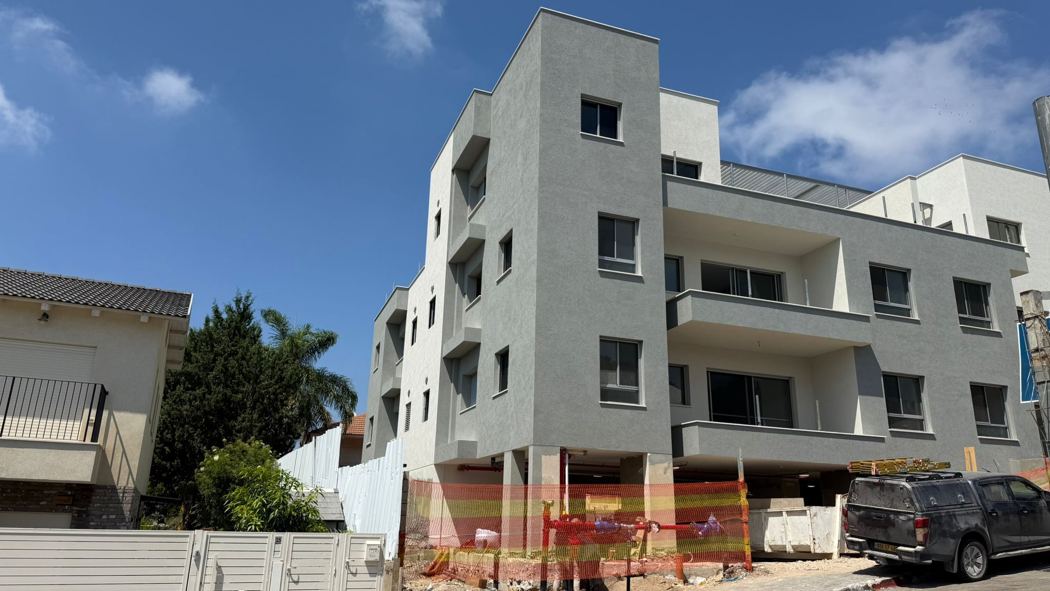
I’m returning to this building I’ve written about before—on the corner of Ha’Oranim Street and Ha’Nassi Street. According to the master plan, four housing units per dunam are permitted in this area. Ziv Deshe previously opposed and blocked such plans. During his current term, Eli Abutbul voted in the Regional Committee in favor of the plan, under which—on an area of less than one dunam (880 square meters)—10 housing units were built! Three stories high (above a ground floor). Side building lines were reduced to two meters instead of four. And only one parking space per apartment was approved (in an area where there is already no parking).
See the photo taken yesterday. This is what the entire center of the town will look like in a few years—tall, crowded, without sufficient parking spaces. Look how it doesn’t fit in with the other houses. And above all, it doesn’t fit in with the historic part of our town. This is a part that should be preserved, not destroyed for the sake of developers’ profits. A local council that does not oppose such construction is harming all residents in favor of developers who have received numerous concessions beyond the master plan.
The Herzl-HaNassi neighborhood up to the Lange complex
The council head hasn’t announced this neighborhood, but in my estimation, it’s quietly taking shape behind the scenes. Probably because it will spark massive opposition from all residents of the town center, which is already congested and overcrowded. And even greater opposition from everyone who wants to preserve the historic character of the town’s heart and understands that residential towers facing Gan Tiul will destroy it. Unfortunately, I have no direct proof, but given the lack of transparency—they aren’t consulting council members or answering my questions—I’ve gathered facts that paint the following alarming picture:
- The Lange Complex agreement is being kept hidden from residents. In the past, Ziv Deshe, as council chair, rejected a proposal from the Israel Land Authority to build 130 housing units on the parking lot where the Maccabi Purim festival takes place—is this plan being revived? Unfortunately, despite my repeated requests, the council members have not provided us with the signed agreement.
- The council head informed us that eviction orders have been issued to businesses located in the old movie theater building on Herzl Street, where the Hertz Deli is located. The reason: the building is unsafe and slated for demolition. My own investigations indicate that local developers have already purchased portions of this building, which was previously privately owned. Part of the building is owned by the council—it is unclear whether the council intends to sell its share to those developers, who would then own the entire property. Given the lack of transparency and since they have not responded to my inquiries on the matter, I can assume that they will. But at what price?
- The soccer field adjacent to this building may also be returned to the council. There is currently a legal dispute over ownership of the complex in question, pitting the council against the Maccabi Trustees Association, which holds the field under a historic agreement. Should the field return to the council’s ownership, it is slated to be demolished and incorporated into a complex that will begin on Herzl Street and extend into the parking lot of the Lange complex.
- In his recent election campaign, the council head presented a video outlining the plan to transform the entire area west of Herzl Street into a residential and office complex, and to add a beautiful plaza as well. In my estimation, the plan and the developers behind it will not be stopped. There will be a dense residential neighborhood along Herzl and HaNassi Streets, extending all the way to the Lange complex.
Zichrona Neighborhood:
Zichrona is the hill above the Moshava High School, adjacent to the Halomot neighborhood. It is a massive neighborhood that has been zoned for residential use since the 1960s. Approximately 1,250 housing units have been approved there, along with an additional 250 units of senior housing. This will result in an increase of approximately 13,000 residents.
Currently, development of the neighborhood is on hold in accordance with the zoning plan guidelines, which were also upheld by a court order for a few more years until sufficient infrastructure is built. But here, in particular, nothing has been done to advance the necessary infrastructure, which consists mainly of new roads.
Two assisted-living facilities
will be built by private developers on their own land. The first, adjacent to the Neve Remez neighborhood, will be built by the Beit El community. The second will be in the Zichrona neighborhood. Regarding the first, the council head held a public meeting where he promoted the plan.
Longtime residents of the community are certainly entitled to purchase assisted living units in the community where they have lived. The population is aging, and assisted living facilities have been built throughout the country. And now it’s Zichron’s turn. This is an important project. But again, the pace and the scale are the issues.
🛑In summary: I feel like the prophet warning at the gate, and no one is listening to him, because everyone is happy to just keep building and building without thinking about the community’s future. Please share this newsletter and comment on my Facebook post.
🛑There are additional construction plans in various stages—see the table I prepared at this link so you can get as complete a picture as possible.