
Limor
Zer Gutman
לימור
זר גוטמן
March 13, 2026
Hello, everyone.
I hope you and your loved ones are safe and taking care of yourselves during this time of war. Let’s hope for good news.
Good news—for about a month now, the newsletter has also been distributed in English. Thank you to the wonderful volunteers who make this possible. Please reach out to your English-speaking friends and invite them to join the English newsletter mailing list. Send me their email addresses. Please make an effort to add more friends to the Hebrew newsletter as well—knowledge is power and transparency.
Here is the summary:
My reason is twofold. First, a lot of essential information is still missing. Second, because the project in its current form (see diagram below) has grown excessively beyond what was agreed upon in the previous term. It has grown to the point where it is profitable for the developers but less beneficial for the residents. And perhaps also for the tenants with whom the developer has not yet signed an agreement—so why the rush?
First Topic: How This Week’s Council Meeting Was Conducted
On Tuesday, despite the situation and the barrage of sirens, we convened for the monthly council meeting. Because the council must continue to operate and provide you with services under any circumstances.
I was very disappointed that during the mayor’s update, he did not deem it necessary to inform us about what was happening in the community during the emergency—the actions being taken, plans, communication with the Home Front Command, and more.
Since the start of Operation “Lion’s Roar,” no updates have been provided to council members—neither in writing nor verbally—and no mandatory committee meetings, such as the Security and Passover Committee, have been convened. We simply do not exist for the council head, and this means that the public, whom the council members represent, is also not receiving reports or transparency. And this is improper management.
During the meeting, two questions and one motion I submitted were discussed, as well as 17 agenda items, which means 17 votes. This newsletter and the one next week will cover this important meeting.
I would like to note that at this meeting, I was able to ask any question and received answers to all of them. This did not happen at the previous meeting, following which I was forced to send a strongly worded letter to the legal advisor and the council auditor, with copies to the council chair and the Ministry of the Interior, in which I clarified the severity of the council chair’s actions and the silence of the gatekeepers. In the letter, I wrote:
Denial of the Right to Speak – The Council Chair acted in violation of Section 39 of the Local Authorities Ordinance when he prevented me from asking questions or addressing issues directly related to Item No. 8 on the agenda, even though I am entitled to at least 10 minutes for each item on the agenda, as granted by law. (See, at 1:15 into the meeting, when I ask to ask the planner a question, the council chair tells me: “No, you’re not asking anything… We’re done.”)
Denying a council member the right to speak is a violation not only of the law but also of the rights of the public that elected me.
During the meeting and at the time of the incident, you, as gatekeepers, did not point out to the council chair that his action was unlawful and contrary to the ordinance, as it prevented and denied a council member the opportunity to address the agenda item in question.
At the upcoming meeting on March 10, 2026, Item 8 will be on the agenda (currently Item 14 on the new agenda). I intend to exercise the minimum 10 minutes to which I am entitled to speak and ask questions on the matter. Hence, I am writing this letter to you so that this time you will take action to ensure the order is not violated and I can exercise my right as a council member.
This letter is not intended to infringe upon any rights reserved for me under the law.
A council meeting must allow every council member to ask questions and receive truthful information. Thus, the right to speak at the meeting and ask tough questions is only the first part—which finally took place at this week’s meeting. The second part is the council chair’s obligation to provide truthful answers. And here we face a serious problem. I have exposed numerous instances in newsletters of false information being presented in the plenary session. Concealing essential information is also a lie. And unfortunately, this was also the case at this week’s meeting.
Thank you for the issues and questions you consistently bring to my attention. I always make sure to respond to each and every one of you.
A huge thank you to the engaged residents who attended the meeting. Thank you also to the 200 residents who watched the live stream! It’s good for all council members to know that residents are engaged and watching.
Second topic: The new Nili parking lot
At the beginning of the meeting, we discussed a motion I submitted regarding the new Nili parking lot, which has approximately 70 parking spaces. The entrance is located to the right of the gas station in the center of the town. The parking lot extends from Nili Boulevard to the intersection with the Bezeq parking lot; a wall runs the entire length between the two lots, so there is no vehicle access, only pedestrian access. The Bezeq parking lot has a meter, and there are additional payment options such as Pango, Cellopark, etc. However, the existing meter is far from most of the parking spaces in the Nili parking lot.
The construction of the parking lot is based on a plan and budget approved during the previous term, including the allocation of hundreds of thousands of shekels from the Ministry of Tourism (we increased the budget due to rising costs).
In a motion, I asked the council to ensure that a parking meter is installed in the new parking lot that opened on Nili Boulevard, which, by the way, is called the Zionist Congress Parking Lot. In the response provided by the council secretary, it was noted that the monthly cost of a parking meter is 1,800 NIS, and currently there is virtually no revenue from this lot, which stands empty most of the day (even before the war)—so there is no economic justification for a parking meter. And drivers who do not have a payment app on their phones will have to go to the adjacent Bezeq lot and use the meter there.
One of the items on the agenda was increasing the budget allocation for the parking lot construction by an additional 100,000 NIS to repair an old wall that began to crumble due to the construction work. This refers to the wall between the two parking lots, which now needs to be converted into a concrete wall. Of course, we approved this unanimously.
The cost of building this parking lot is 2.356 million NIS. It’s a new, well-organized parking lot that I’m already using a lot.
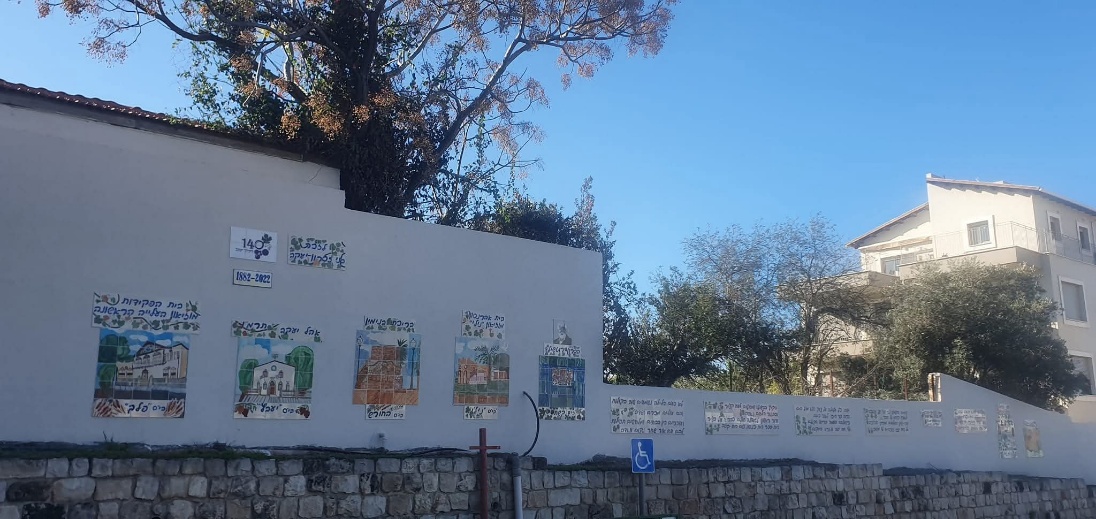
During the meeting, I asked the council head about the beautiful heritage wall that once stood in the Nili parking lot. It is a wall, part of which still stands, that was decorated at the time to mark the town’s 140th anniversary, lovingly prepared by Nira Efrati and the students of the schools in Zichron Ya’akov
The wall decorations, which told the story of the settlement and its sites, were partially destroyed during the construction of the parking lot. The council head apologized to Nira Efrati and agreed with her that the heritage wall decorations would be rebuilt, and the council would allocate the necessary resources. So thank you to Nira Efrati for taking care of this matter again, and we are all looking forward to seeing the new wall. (Attached is a photo of the unique, decorated wall that was there and was destroyed.)
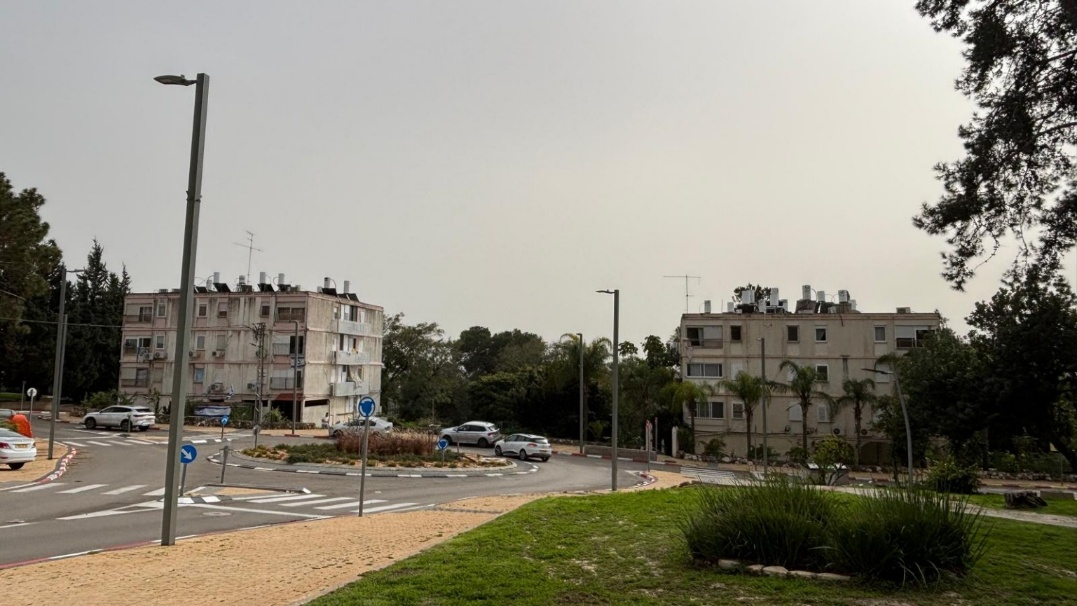
Third topic: Approval of the council’s participation as an initiator of the urban renewal plan on HaTirosh Street, Neve Sharet
A brief reminder: This is a mega-project in which the two buildings shown in the photo—which currently contain 28 apartments and a lot of green space—will be demolished. According to the plan the Council will submit as the developer, the site will be transformed into a complex comprising 135 apartments with vast commercial and public spaces. This means increased traffic and uncontrolled densification at the central intersection in the Neve Sharet neighborhood. This deviates from what was approved in a similar, adjacent project involving the Railway Buildings on Marvad HaKsamim Street. There, a demolition project for 36 units has already been approved—resulting in 130 new units. That is, a ratio of approximately 3.5 new units for every existing unit. Whereas in the new plan on HaTirosh Street, the ratio presented to us is 4.8 new units for every existing unit!
In addition to the three residential buildings agreed upon during the previous term, the mayor presented plans to build two additional towers in the same area. Another residential tower above the existing health clinic building (a new health clinic is planned to be built, with a residential tower above it) containing dozens of housing units. And another office tower above the “Pitzutzit HaGamad.”
Clearly, we are all in favor of urban renewal—it’s excellent for residents who will be relocated and receive a new, improved property, including residential protection, and it’s good for the community. But in this project, there is more to it than meets the eye.
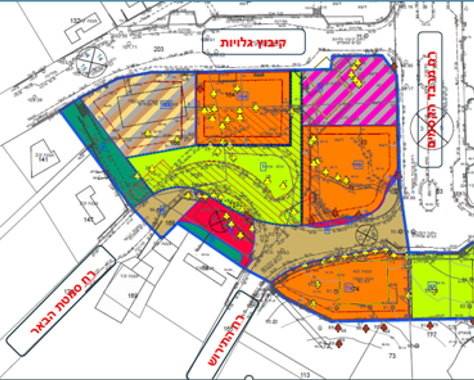
Earth brown – 3 residential buildings, 135 units total
Brown/yellow/gray striped area – residential units above a health clinic building
Purple/gray striped area – office tower, employment
At a previous meeting, one of the project’s developers—Tzachi Barco—and the developers’ planner appeared before us. The council head prevented me from asking the planner questions, contrary to the law and the Local Authorities Ordinance, so I was left with many unanswered questions. I have already written about these in detail in the newsletters. The vote was postponed to the next meeting, which took place this week—whether to approve the council’s inclusion as a project sponsor, which would lead to the plan being submitted by the local council, since the two developers are not listed in the plan.
This week, the council head explained that this is a “technical matter” in which the council must join as the plan’s initiator because its territory also includes public areas and roads belonging to the council. This is despite the fact that the plan primarily concerns land belonging to the Israel Land Authority, as its land is the complementary land in the project. And without the ILA’s consent, there will be no project.
At this week’s meeting, it became clear that I was right all along when I argued that the council must not join as an initiator as long as it has no agreement with the developers. So this week, it was suddenly stated that such an agreement must exist, and the council’s legal advisor will ensure the agreement is in place, and the plan will not be submitted until after the agreement is signed (which must also be brought before the council plenary for approval). I hope that in the future, there won’t be more things I’ve said that turn out to be true. For example, why rush to submit a plan before knowing for certain that the developers have a signed agreement with the tenants, and when there is no signed agreement with the Israel Land Authority, which owns the land needed to complete the project? And without it, there is no project, or what are the decisions of the Urban Renewal Authority, which is the body that approves the ratio between the number of old apartments and the number of new apartments to be built.
I’m reminding you of what I wrote in a previous newsletter—that I consulted with lawyers specializing in urban renewal who didn’t understand why the council needs to be the developer of a project in which it doesn’t own at least 25% of the land. And I still don’t understand who this move benefits.
At this week’s meeting, I was the only one who voted against it. Everyone else supported it.
Fourth topic: The Zichron Ya’akov Honorary Citizens Committee
The surprise of the meeting was regarding this issue. When the chairman of the Zichron Yaakov Honorary Citizens Committee, Ilan Amrani, announced at the meeting his resignation from the position and that the committee could not select the recipients of the award. Ilan said:
“…Throughout the process, we tried to do a good and fair job; we established committee bylaws and tried to create an orderly and transparent selection process. But after the candidates were selected, I received inquiries and updates indicating that in some cases there were inaccuracies in the details listed on their resumes. At the same time, over the past year and during the war, we’ve seen amazing people volunteering… Amid all this, I realized we need to rethink how the committee operates. In my opinion, the committee that selects the community’s honorees should be more professional and free of politicians. Therefore, I have decided—both out of a sense of responsibility and from the heart—to resign from my position as committee chair. I would like to take this opportunity to apologize to the residents who submitted their candidacies and were even selected, but in the end, the matter did not come to fruition.”
You can listen to his remarks starting at 1:05 in the recording of the meeting—
The council head added that politics had triumphed over the committee and that in most cases there was no connection between the people selected and their contribution to the community. A situation has arisen where it is possible to select just about anyone walking across a crosswalk. Whereas Yakir is someone who has contributed and continues to contribute to the community in so many ways over the course of decades.
I tried to ask Deputy Mayor Meir Vanunu, who was the committee chair during the previous term, whether these serious allegations of politicization, failure to provide accurate information, and disregard in the selection of individuals were true. If so, this is a serious matter. The council chairman forbade Vanunu from responding, claiming that this was not the subject of the discussion.
So I have no choice but to accept Ilan Amrani’s testimony, since the rule of evidence is that if a person incriminates himself and admits to improper conduct—it means it is true, because “no one makes himself out to be wicked.” So apparently there were serious flaws that have prevented this award from being granted for two years now. I feel sorry for all the dear people who submitted nominations and are waiting. It would have been right to approve those selected up to this year and, starting in 2026, to act according to a new decision.
The proposal we voted on was to completely change the committee’s composition into a professional committee that would not include council employees or council members. I certainly prefer an independent professional committee to the council chair. So we all voted unanimously in favor of changing the composition and that the identities of the public figures who would sit on it be submitted to the council for approval.
The council chair asked us to consider suitable candidates for the role—people of stature who may also have experience on selection committees of this kind (in any field)—and that is why I am reaching out to you: anyone who sees themselves as a good fit for this important role, please contact me as soon as possible. The community needs good people to serve on this committee.
